PE Doesn't Fail at Close
The close is the easy part. I’ve watched a lot of deals get to the table, and I’ve never seen one die there. The lawyers are good, the model is tight, the wire goes out, somebody orders champagne. Everyone in the room treats the signature as the finish line.
It’s the starting line. The first ninety days are where the money actually gets made or quietly lost — usually on the one thing the model has no line for.
People.
The failure mode is almost always the same. The deal team builds a synergy case that assumes a clean cutover and a compliant org. Then you take possession of the asset and discover the asset is a building full of people who found out they’d been sold from a press release. Nobody told them anything. So they do what every human does in an information vacuum: they write their own story, and it’s the worst version available. We’re getting cut. The brand’s dead. I don’t know who I report to Monday, so I’m taking the recruiter call I’ve been ignoring. They start making real decisions on the fiction. And in a messy company — the kind that’s for sale precisely because it’s messy — the people writing that story are the same people carrying the institutional knowledge in their heads. That knowledge is the asset. It walks out on two legs in the first ninety days, right in the window your model assumed a smooth integration.
That’s not a culture problem. That’s value leakage with a heartbeat.
I learned this on GigaMonster, an add-on we integrated that was about as hard as they come. Hostile territory, bankrupt for years, a workforce that had been jerked around so long they had every reason to meet us with knives out. Bilingual, too — half the team was in Costa Rica. On paper the integration risk was off the charts.
We walked in expecting a fight. What we found was simpler and more useful: people who were exhausted from being lied to and just wanted the truth. So I made them a pact in the first meeting — I’d be straight with them, every time, even when the news was bad. Especially when it was bad. When we didn’t know an answer, we said so, and came back when we did.
Then we earned it the slow way, because there’s no fast way. We showed up. We made sure every level of the org — not just the managers — knew we were there for them. I flew our board down to sit in the same room, because nothing says “we’re in this with you” like the people who own the thing showing up in person. And the weekend before Christmas, on no notice, I got on a plane to Costa Rica with a suitcase full of American food and my genuinely terrible Spanish. It was not optimal. It was the point. The U.S. team saw we’d do anything; the Costa Rica team saw we’d come to them.
The hard part wasn’t the kindness. The hard part was that I couldn’t keep everyone, and some of the people I had to let go were flat-out stars I’d have fought to keep if we’d had the room. This is where a lot of operators get cute and start managing perception. We didn’t. We told people the truth, treated everyone with the same dignity whether the news was good or bad, kept folks on as long as we possibly could, paid real severance, and worked our network to place them somewhere good. Word travels. When you handle the people you can’t keep with respect, the people you do keep start to believe you.
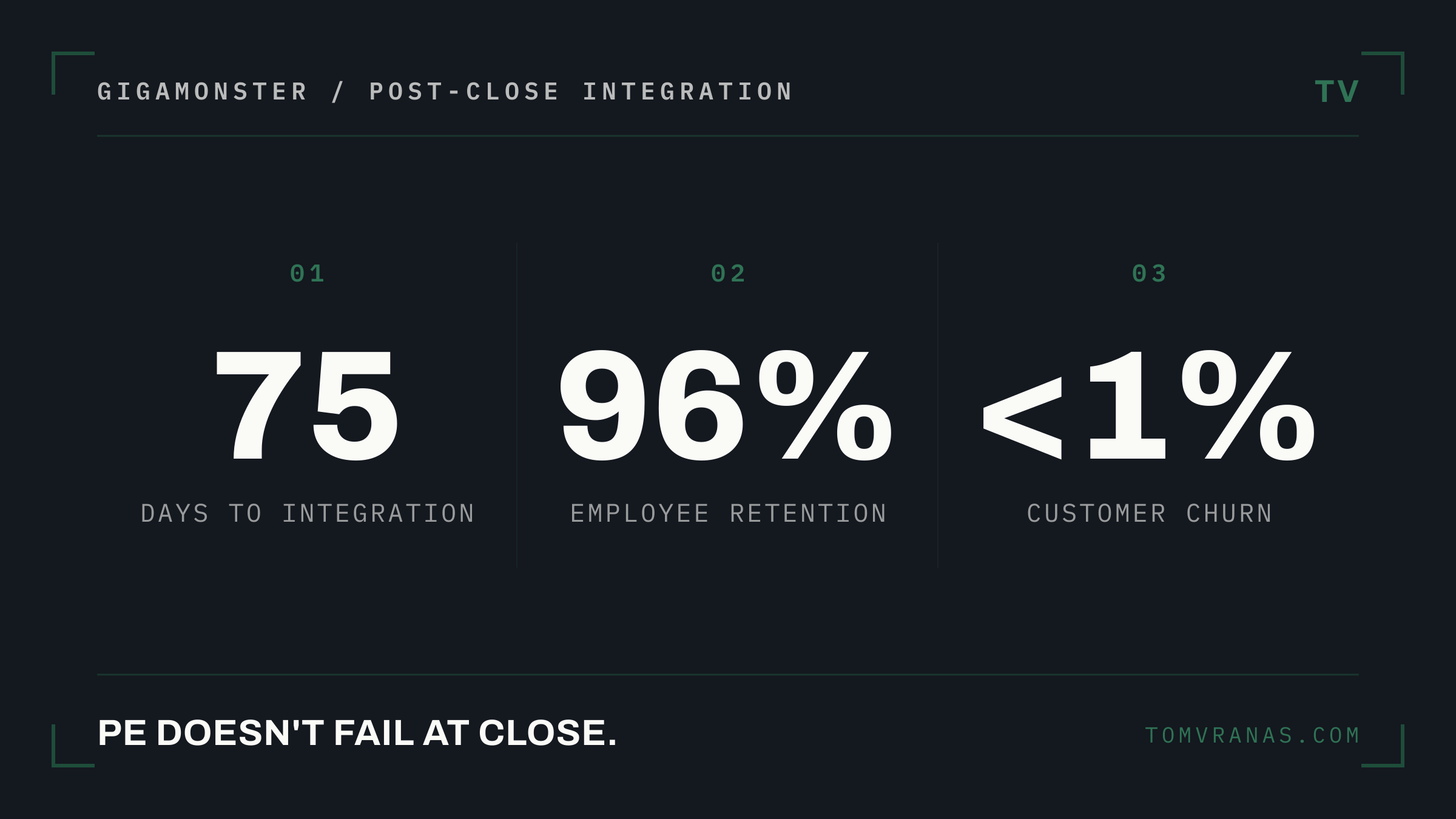
And they stayed. The load-bearing people — the ones who knew how the network was actually wired and which customers would walk if you looked at them sideways — stayed, and we got them into our systems on day one. The cutover was boring. Boring is the highest compliment you can pay an integration. Substantively integrated in 75 days, 95% of the people kept, customer churn under 1% — in the exact window everyone assumes you’ll bleed.
There was a second front, and this is the part a sponsor should care about more than the suitcase story. The chaos wasn’t only on their side. My own team was getting whipsawed — replanning, re-reviewing, fielding a hundred questions a day, all while this was our second integration in quick succession and everyone still had a day job. So I made myself the keeper of information. I absorbed the ambiguity on purpose, so the team could spend their few real hours of the week doing the work instead of hunting for scope, sequence, and status. We ran tight standing meetings and eventually split them by work area, so people only got the news they actually needed. And because deal one had gone well and I’d already banked trust inside my own org, I could tell them what was coming earlier than is comfortable. That’s a risk — information moves — but it let us stand teams up sooner, and it’s the reason the second integration ran faster than the first.
That’s the whole game, and it’s why this is a machine and not a feel-good story: trust compounds. Earn it on deal one and you move faster on deal two. The buy-and-build thesis lives or dies on whether the integration is repeatable, and integration is only repeatable if the operator running it is believed.
So when I tell a partner I care about people, I’m not making a soft point. I’m making the hardest financial point there is. You can model synergies; you cannot model them into existence. The spreadsheet says the value is there. Someone still has to walk into a silent, frightened building and hold it together long enough for the number to become real. That’s the job. It doesn’t happen at the close. It happens in the first ninety days nobody budgeted for.
The close isn’t where deals fail. It’s where they start. If you’re looking at one you just signed and the integration plan is a synergy model and a prayer, that’s the conversation to have now — before the fire, not after it.
Fix, grow, systematize, exit. That’s the job.